6.2 - Respiratory and Confined-Space Hazards
Module: Safety Leak Detection Shipping and Safe Disposal
Safety and regulatory verification date: August 10, 2026
Primary safety authorities: Current EPA Section 608 test topics and current OSHA respiratory-protection and permit-required-confined-space requirements
Course role: Explains oxygen displacement, asphyxiation, refrigerant-vapor accumulation, cardiac effects, evacuation, ventilation, self-contained breathing apparatus, and confined-space limits relevant to refrigerant service
Learning Objectives
After completing this section, a student should be able to:
- Explain how a refrigerant release can displace air and create an oxygen-deficient atmosphere.
- Explain why oxygen deprivation can cause asphyxiation, unconsciousness, and death.
- Explain why many common refrigerant vapors can accumulate in low areas when they are denser than air, while recognizing that this behavior is not universal for every refrigerant.
- Distinguish oxygen-displacement hazards from the direct toxic, central-nervous-system, and cardiac effects that some refrigerants can produce at high concentrations.
- State the OSHA oxygen-deficiency threshold of less than 19.5% oxygen by volume.
- Explain why a machinery room, pit, tank, crawl space, or other work area must be evaluated according to its actual geometry and hazards rather than being assumed safe because the refrigerant is normally used in HVAC equipment.
- Distinguish a confined space from a permit-required confined space under OSHA general-industry terminology.
- Explain why evacuation and ventilation are primary responses to a significant refrigerant release.
- Explain when self-contained breathing apparatus (SCBA) or another approved atmosphere-supplying respirator is required and why an ordinary air-purifying respirator cannot correct an oxygen-deficient atmosphere.
- Apply a safe decision process to refrigerant-release and confined-space scenarios without attempting an unplanned rescue or entry into an unknown atmosphere.
Introduction
A refrigerant does not have to be highly toxic or flammable to create a life-threatening atmosphere.
A large refrigerant release can create danger simply by displacing ordinary air.
Normal air contains approximately 21% oxygen. If refrigerant vapor occupies an increasing fraction of a room, pit, vessel, or other enclosed area, the concentration of oxygen available for breathing can fall. The person entering the space may then experience:
- Impaired judgment.
- Dizziness.
- Loss of coordination.
- Loss of consciousness.
- Inability to escape.
- Asphyxiation.
- Death.
EPA’s current Section 608 test-topic guidance specifically includes:
oxygen deprivation
+
cardiac effects
+
self-contained breathing apparatus (SCBA) in extreme cases
as technician safety topics.
The danger can be increased by the physical behavior of the refrigerant vapor. Many commonly used halocarbon refrigerant vapors are denser than air and can collect in low areas when ventilation and air mixing are inadequate.
Examples of locations that can become especially hazardous include:
- Pits.
- Floor depressions.
- Trenches.
- Below-grade equipment areas.
- Tanks or vessels.
- Small mechanical spaces.
- Low portions of poorly ventilated rooms.
However, not every refrigerant is heavier than air. Refrigerant properties must be checked from the specific Safety Data Sheet (SDS) and manufacturer information.
A second important principle is that oxygen deprivation is not the only inhalation hazard. Some refrigerants can produce central-nervous-system effects or cardiac sensitization at sufficiently high vapor concentrations. Therefore, a space cannot be declared safe merely because the oxygen concentration has not yet fallen below the oxygen-deficiency threshold.
This section develops the respiratory and confined-space principles needed for EPA Section 608 preparation and safe field judgment.
Direct-contact hazards, frostbite, eye exposure, and PPE were covered in Section 6.1 - Personal Protective Equipment and Refrigerant Exposure.
Fire, ignition, and thermal-decomposition hazards are covered in Section 6.3 - Fire Explosion and Decomposition Hazards.
Key Concepts
1. Refrigerant Can Displace Oxygen
Air is a mixture of gases.
When a large quantity of refrigerant vapor enters a space, it can replace part of the normal air.
Conceptually:
Normal air in space
+
large refrigerant release
→ refrigerant occupies part of the space
→ less ordinary air remains
→ oxygen concentration can decrease
This is called oxygen displacement.
The refrigerant does not have to chemically consume oxygen for this hazard to occur.
It can simply take up volume that was previously occupied by air.
2. Oxygen Deficiency Can Cause Asphyxiation
Asphyxiation occurs when the body does not receive enough oxygen to maintain normal function.
As oxygen availability decreases, possible effects include:
- Reduced alertness.
- Poor judgment.
- Increased breathing effort.
- Dizziness.
- Weakness.
- Confusion.
- Loss of coordination.
- Collapse.
- Unconsciousness.
- Death.
The exact onset and severity depend on:
- Oxygen concentration.
- Duration of exposure.
- Work intensity.
- Individual health.
- Altitude.
- Presence of other contaminants.
A critical safety problem is that a person may lose judgment or physical ability before recognizing the seriousness of the atmosphere.
For that reason:
"I feel okay"
≠
proof that the atmosphere is safe
3. OSHA Oxygen-Deficiency Threshold
Under OSHA general-industry confined-space terminology:
Oxygen-deficient atmosphere
→ less than 19.5% O₂ by volume
OSHA also defines an oxygen-enriched atmosphere as:
more than 23.5% O₂ by volume
For EPA 608 preparation, the most important value in this section is:
Less than 19.5% oxygen = oxygen-deficient atmosphere.
This is an occupational-safety threshold, not a Section 608 refrigerant-recovery endpoint.
Do not confuse it with:
- Refrigerant concentration limits.
- Refrigerant pressure.
- Evacuation vacuum.
- Recovery percentage.
- Machinery-room refrigerant-monitor setpoints.
4. Many Refrigerant Vapors Can Collect in Low Areas
Many common halocarbon refrigerant vapors have a molecular mass greater than that of air.
When released with limited mixing, they may tend to move toward or accumulate in low areas.
A simplified pattern is:
Refrigerant release
        ↓
vapor spreads through room
        ↓
denser vapor can collect near floor
        ↓
pit / trench / low area may reach a higher concentration
        ↓
oxygen concentration in that zone may decrease
This is particularly important when:
- The room has little air movement.
- The release is large.
- The leak continues for a long time.
- The space is below grade.
- A pit or trench allows vapor to collect.
- Exhaust or makeup ventilation is inadequate.
- The technician is kneeling or working close to the floor.
5. “Heavier Than Air” Is Not a Universal Refrigerant Rule
An older HVAC rule of thumb often says:
Refrigerant vapor is heavier than air.
That statement is too broad.
A better rule is:
Many common refrigerant vapors are denser than air, but vapor density must be checked for the specific refrigerant.
For example, ammonia vapor is lighter than air under ordinary conditions, while many fluorinated refrigerants are substantially denser than air.
The location of the greatest hazard therefore depends on:
- Refrigerant vapor density.
- Release temperature.
- Release direction.
- Room geometry.
- Air movement.
- Mechanical ventilation.
- Thermal currents.
- Mixing.
Do not rely on density alone to predict a real release.
6. Low Areas Can Be More Dangerous Than the Main Room
A technician standing in the main room may be exposed to a lower vapor concentration than a person entering a:
- Pit.
- Trench.
- Sump.
- Tank.
- Vessel.
- Below-grade enclosure.
This creates an important safety trap.
The atmosphere at one elevation does not automatically represent the atmosphere at another elevation.
For a potentially hazardous space:
Test where the worker will actually breathe
+
consider vertical concentration differences
Atmospheric testing and confined-space procedures must follow the applicable workplace program.
7. Odor Is Not a Reliable Safety Monitor
A technician should not depend on smell to determine whether a refrigerant atmosphere is safe.
Reasons include:
- Some refrigerants have little or no useful warning odor.
- Odor thresholds differ among individuals.
- The sense of smell can become fatigued.
- A dangerous oxygen-deficient atmosphere may not have an obvious odor.
- A refrigerant concentration can be hazardous before a person recognizes it subjectively.
Therefore:
No odor
≠
no refrigerant
≠
safe atmosphere
Use the appropriate:
- Refrigerant monitor.
- Gas detector.
- Oxygen meter.
- Atmospheric-testing instrument.
- Workplace entry procedure.
8. Oxygen Deprivation and Refrigerant Toxicity Are Different Hazards
Two different inhalation mechanisms can exist.
Hazard A — Oxygen Displacement
Refrigerant vapor replaces air
→ oxygen concentration falls
→ asphyxiation hazard
Hazard B — Direct Refrigerant Effect
High refrigerant concentration
→ chemical / physiological effect
→ CNS effects, cardiac effects, or other product-specific toxicity
These hazards can occur together.
A technician must not assume:
Oxygen ≥ 19.5%
→ every refrigerant concentration is safe
The applicable refrigerant exposure limit and SDS must also be considered.
9. High Vapor Concentrations Can Affect the Central Nervous System
Some refrigerants at high inhaled concentrations can affect the central nervous system (CNS).
Possible effects described for certain refrigerants include:
- Light-headedness.
- Dizziness.
- Intoxication-like effects.
- Poor coordination.
- Drowsiness.
- Loss of consciousness.
The exact effects depend on the refrigerant and concentration.
A person experiencing symptoms must not remain in the atmosphere merely because a monitor has not alarmed.
The safe response is to:
leave the exposure area
→ move to a safe atmosphere
→ obtain assistance
→ follow SDS and emergency procedures
10. Cardiac Sensitization Is a Separate High-Concentration Hazard
EPA includes cardiac effects as a Section 608 safety topic.
Certain halocarbon vapors, at sufficiently high concentrations, can increase the heart’s sensitivity to naturally occurring catecholamines such as epinephrine.
This effect is commonly called cardiac sensitization.
The concern is that a sufficiently high exposure can increase the risk of abnormal heart rhythms.
Conceptually:
High concentration of certain refrigerant vapors
→ increased cardiac sensitivity
→ greater risk of arrhythmia
This is especially important because a person exposed during an emergency may also experience:
- Fear.
- Physical exertion.
- Stress.
The student should remember the concept, not attempt to diagnose or treat the condition.
If a significant inhalation exposure is suspected:
- Remove the person from exposure when this can be done safely.
- Obtain emergency medical assistance.
- Provide responders with the refrigerant identity and SDS.
- Follow the product-specific medical guidance.
11. Evacuation Comes Before Troubleshooting
If a significant refrigerant release creates an unsafe or uncertain atmosphere:
EVACUATE
Do not remain in the space to:
- Finish the recovery job.
- Find the exact leak.
- Retrieve tools.
- Silence an alarm.
- Close a distant valve.
- Restart equipment.
unless the task is part of an established emergency procedure and the person is specifically trained and equipped to perform it.
A correct technical diagnosis is not worth entering an unsafe atmosphere.
12. Ventilation Reduces Vapor Concentration
Ventilation can dilute and remove refrigerant vapor.
A basic ventilation response is:
Contaminated room air
→ exhaust to a safe location
+
replacement / makeup air enters
→ refrigerant concentration decreases
Ventilation may be:
- Normal building ventilation.
- Dedicated machinery-room ventilation.
- Emergency mechanical exhaust.
- Portable ventilation used under an approved procedure.
However:
Ventilation must not be assumed effective merely because a fan is running.
The actual result depends on:
- Exhaust location.
- Makeup-air location.
- Airflow rate.
- Room geometry.
- Refrigerant density.
- Obstructions.
- Dead zones.
- Release rate.
- Applicable code and manufacturer requirements.
Detailed machinery-room ventilation and monitoring are covered in Section 6.7 - Machinery-Room Safety.
Technical and Safety Details
1. Normal Air and Oxygen Concentration
Normal dry atmospheric air near sea level contains approximately:
21% oxygen
The exact percentage is commonly treated as about 20.9%.
If another gas displaces part of the air, the percentage of oxygen decreases because less normal air remains in the mixture.
This is why gases that are sometimes called simple asphyxiants can be dangerous even when they do not directly poison the body at the concentration involved.
2. Why Low-Point Accumulation Can Occur
When a dense refrigerant vapor is released, several processes occur:
- Gravity can promote density stratification.
- Turbulence mixes refrigerant with air.
- Warm surfaces and thermal currents create convection.
- Fans and ventilation move the mixture.
- A high-velocity release can initially entrain large amounts of surrounding air.
Therefore, the real concentration pattern is not a perfectly separated layer.
A more accurate teaching model is:
Dense refrigerant vapor can create higher concentrations near low areas, especially when mixing and ventilation are weak.
This is preferable to imagining a perfectly sharp boundary between “air above” and “refrigerant below.”
3. Low-Level Ventilation Can Matter
For a refrigerant whose vapor is substantially denser than air, exhaust pickup near low points can help remove vapor that tends to collect there.
Potential problem locations include:
- Floor level.
- Machinery pits.
- Depressions.
- Trenches.
- Below-grade rooms.
Actual ventilation-system design must follow:
- Current codes.
- Refrigerant classification.
- Refrigerant quantity.
- Machinery-room requirements.
- Manufacturer instructions.
- Local authority requirements.
Do not use a generic floor-exhaust rule as a substitute for code-compliant design.
4. Ventilation Does Not Automatically Authorize Entry
Suppose a release occurs in a mechanical room and an exhaust fan is started.
The following conclusion is unsafe:
Fan ON
→ room automatically safe
Instead:
Ventilate
→ evaluate / monitor atmosphere
→ confirm acceptable conditions
→ follow applicable entry procedure
→ re-enter only when authorized
A fan can fail, be undersized, create poor mixing, or leave a low pocket of vapor.
5. Atmospheric Testing
When a confined-space or hazardous-atmosphere procedure requires testing, the test instruments must be:
- Appropriate to the expected hazard.
- Properly maintained.
- Used according to manufacturer instructions.
- Calibrated or function-checked as required.
- Used at the locations and elevations relevant to the worker.
Depending on the hazard assessment, testing may include:
- Oxygen concentration.
- Flammable-gas concentration.
- Specific toxic or refrigerant concentration.
For confined-space work, atmospheric testing is part of a larger entry-control program rather than an isolated meter reading.
6. A Refrigerant Detector and an Oxygen Meter Answer Different Questions
A refrigerant monitor asks:
How much of the target refrigerant is present?
An oxygen meter asks:
How much oxygen is present?
One instrument does not necessarily replace the other.
For example:
- Oxygen can be acceptable while the refrigerant concentration exceeds a product exposure limit.
- A refrigerant monitor can alarm even though oxygen has not yet fallen below 19.5%.
- A non-target refrigerant or another gas may not be detected by a refrigerant-specific sensor.
Use the instruments required by the hazard assessment.
Confined-Space Safety
1. OSHA Definition of a Confined Space
Under OSHA’s general-industry permit-required-confined-space standard, a confined space must meet all three conditions:
- It is large enough and configured so that an employee can bodily enter and perform work.
- It has limited or restricted means for entry or exit.
- It is not designed for continuous employee occupancy.
Examples that may satisfy these characteristics include:
- Tanks.
- Vessels.
- Vaults.
- Pits.
- Silos.
- Hoppers.
- Certain crawl spaces.
A space is not a confined space merely because it feels small.
2. A Mechanical Room Is Not Automatically a Confined Space
A refrigeration machinery room may contain refrigerant hazards, but it is not automatically an OSHA-defined confined space.
A typical occupied machinery room may have:
- Normal doors.
- Designed access.
- Regular employee occupancy.
- Permanent ventilation.
It may therefore fail one or more parts of the confined-space definition.
However, a machinery room can still contain a hazardous atmosphere.
Conversely, a:
- Chiller pit.
- Tank.
- Vessel.
- Vault.
- Below-grade enclosure.
may meet the confined-space definition.
Always classify the actual space.
3. Permit-Required Confined Space
A permit-required confined space, commonly called a permit space, is a confined space with one or more additional serious hazards.
These include a space that:
- Contains or could contain a hazardous atmosphere.
- Contains material that could engulf an entrant.
- Has a configuration that could trap or asphyxiate an entrant.
- Contains another recognized serious safety or health hazard.
A confined space with the potential for a significant refrigerant release can therefore require permit-space controls when the regulatory criteria are met.
4. Hazardous Atmosphere Limits
Under OSHA’s general-industry confined-space standard, a hazardous atmosphere includes:
oxygen < 19.5%
or:
oxygen > 23.5%
It can also include:
- Flammable gas, vapor, or mist above the applicable confined-space criterion.
- Excessive toxic contaminant concentration.
- Another atmosphere that is immediately dangerous to life or health.
For Section 6.2, the high-priority value is:
19.5% O₂
because refrigerant release can reduce oxygen concentration.
5. Unknown Atmospheres Must Be Treated Seriously
Under OSHA respiratory-protection rules, when the employer cannot identify or reasonably estimate the respiratory exposure, the atmosphere must be considered immediately dangerous to life or health (IDLH) for respirator-selection purposes.
This supports a very important field rule:
Unknown atmosphere
≠
safe atmosphere
Do not enter an unknown refrigerant-release atmosphere simply because:
- No one sees vapor.
- No odor is noticed.
- The leak appears to have stopped.
- The room door has been open for a few minutes.
- Another person entered briefly and returned.
6. Do Not Attempt an Unplanned Confined-Space Rescue
A person collapsed in a contaminated space creates an emergency.
The instinct to enter immediately can create a second victim.
A safe response requires:
- Emergency notification.
- Trained rescue personnel.
- Appropriate respiratory protection.
- Required attendants and entry controls.
- Retrieval or rescue equipment where applicable.
- Atmospheric evaluation.
- An established rescue procedure.
For examination preparation:
Do not enter a refrigerant-contaminated or oxygen-deficient confined space without the required training, equipment, and entry/rescue procedure.
Respiratory Protection and SCBA
1. What SCBA Means
Self-contained breathing apparatus (SCBA) supplies breathing gas from a source carried by the user.
The essential idea is:
SCBA
→ carries its own breathing-air supply
→ does not depend on contaminated room air for oxygen
EPA lists SCBA as personal protective equipment for extreme cases in the Section 608 test-topic guidance.
2. Air-Purifying Respirators Do Not Supply Oxygen
An air-purifying respirator works by passing ambient air through:
- A filter.
- A cartridge.
- A canister.
It does not create oxygen.
Therefore:
Oxygen-deficient atmosphere
→ air-purifying respirator is not the solution
If the surrounding atmosphere does not contain enough oxygen, filtering contaminants from that atmosphere does not make it breathable.
This is a major examination and safety distinction.
3. IDLH Atmospheres Require Atmosphere-Supplying Respiratory Protection
Under OSHA general-industry respiratory-protection requirements, an employee entering an IDLH atmosphere must be provided with an approved configuration such as:
- A NIOSH-certified full-facepiece pressure-demand SCBA with at least a 30-minute service life, or
- A qualifying full-facepiece pressure-demand supplied-air respirator with an auxiliary self-contained air supply.
For this course, remember the principle rather than attempting to select emergency respiratory equipment independently:
IDLH / oxygen-deficient / unknown dangerous atmosphere
→ atmosphere-supplying respiratory protection
→ trained personnel under a respiratory-protection program
4. SCBA Is Not Ordinary Technician PPE
A technician should not interpret the EPA test-topic phrase “SCBA in extreme cases” to mean:
Buy SCBA
→ put it on
→ enter any refrigerant leak
OSHA respiratory-protection programs involve requirements such as:
- Hazard evaluation.
- Medical evaluation.
- Respirator selection.
- Fit testing.
- Training.
- Inspection.
- Maintenance.
- Written procedures.
- Emergency-use procedures.
SCBA is specialized life-safety equipment.
5. Escape Is Different From Entry
Emergency escape equipment is intended to help a person leave a dangerous atmosphere.
It is not automatically approved for:
- Entering an IDLH atmosphere.
- Leak repair.
- Rescue.
- Troubleshooting.
Always distinguish:
ESCAPE
from
ENTRY
The respiratory equipment must be approved for the intended use.
Refrigerant-Release Response
1. Initial Response
A simplified safe response to a significant refrigerant release is:
Recognize release / alarm
→ warn others
→ leave the affected area
→ move to safe air
→ notify appropriate emergency or facility personnel
→ ventilate according to established procedure
→ monitor / evaluate atmosphere
→ re-enter only when authorized and safe
2. If a Person Shows Inhalation Symptoms
Possible warning signs can include:
- Dizziness.
- Headache.
- Confusion.
- Poor coordination.
- Drowsiness.
- Unusual heartbeat sensation.
- Collapse.
- Unconsciousness.
If symptoms occur:
remove from exposure if this can be done safely
→ call for medical assistance
→ provide refrigerant identity and SDS
Do not enter an unsafe atmosphere without proper respiratory protection and rescue procedures.
3. If an Alarm Activates
Treat a refrigerant or oxygen alarm as a safety signal.
Do not:
- Disable the alarm merely because no odor is present.
- Assume the sensor is wrong without evaluation.
- Remain in the room to finish a routine task.
- Re-enter simply because the audible alarm stops.
Follow the facility emergency procedure.
4. Before Re-Entry
Re-entry should be based on:
- The actual hazard assessment.
- Appropriate atmospheric measurements.
- Applicable workplace procedures.
- Refrigerant-specific exposure information.
- Confined-space requirements when applicable.
- Facility or machinery-room requirements.
Do not base re-entry solely on elapsed time.
Important Terms
Asphyxiation
Loss of adequate oxygen supply to the body.
A large refrigerant release can contribute to asphyxiation by displacing normal air.
Cardiac Sensitization
An increased sensitivity of the heart to catecholamines associated with sufficiently high exposure to certain chemicals, including some halocarbon refrigerants.
The effect can increase the risk of abnormal heart rhythms.
Confined Space
Under OSHA general-industry terminology, a space that:
- Can be bodily entered for work.
- Has limited or restricted entry or exit.
- Is not designed for continuous employee occupancy.
Hazardous Atmosphere
An atmosphere capable of causing death, incapacitation, impairment of self-rescue, injury, or acute illness because of oxygen level, flammable materials, toxic contaminants, or another serious atmospheric condition.
Immediately Dangerous to Life or Health (IDLH)
A condition posing an immediate or delayed threat to life, irreversible adverse health effects, or interference with a person’s ability to escape unaided.
Oxygen Deficiency
Under OSHA general-industry definitions:
less than 19.5% oxygen by volume
Oxygen Displacement
Reduction of the normal oxygen-containing air in a space because another gas or vapor occupies part of the volume.
Permit-Required Confined Space
A confined space with one or more serious additional hazards, such as a hazardous atmosphere, engulfment hazard, trapping configuration, or other recognized serious hazard.
Self-Contained Breathing Apparatus (SCBA)
An atmosphere-supplying respirator in which the breathing-gas supply is designed to be carried by the user.
Vapor Density
A comparison of the density of a vapor with the density of air.
A vapor denser than air may tend to create higher concentrations in low areas under poorly mixed conditions.
Figures and Diagrams
Figure 6.2.1
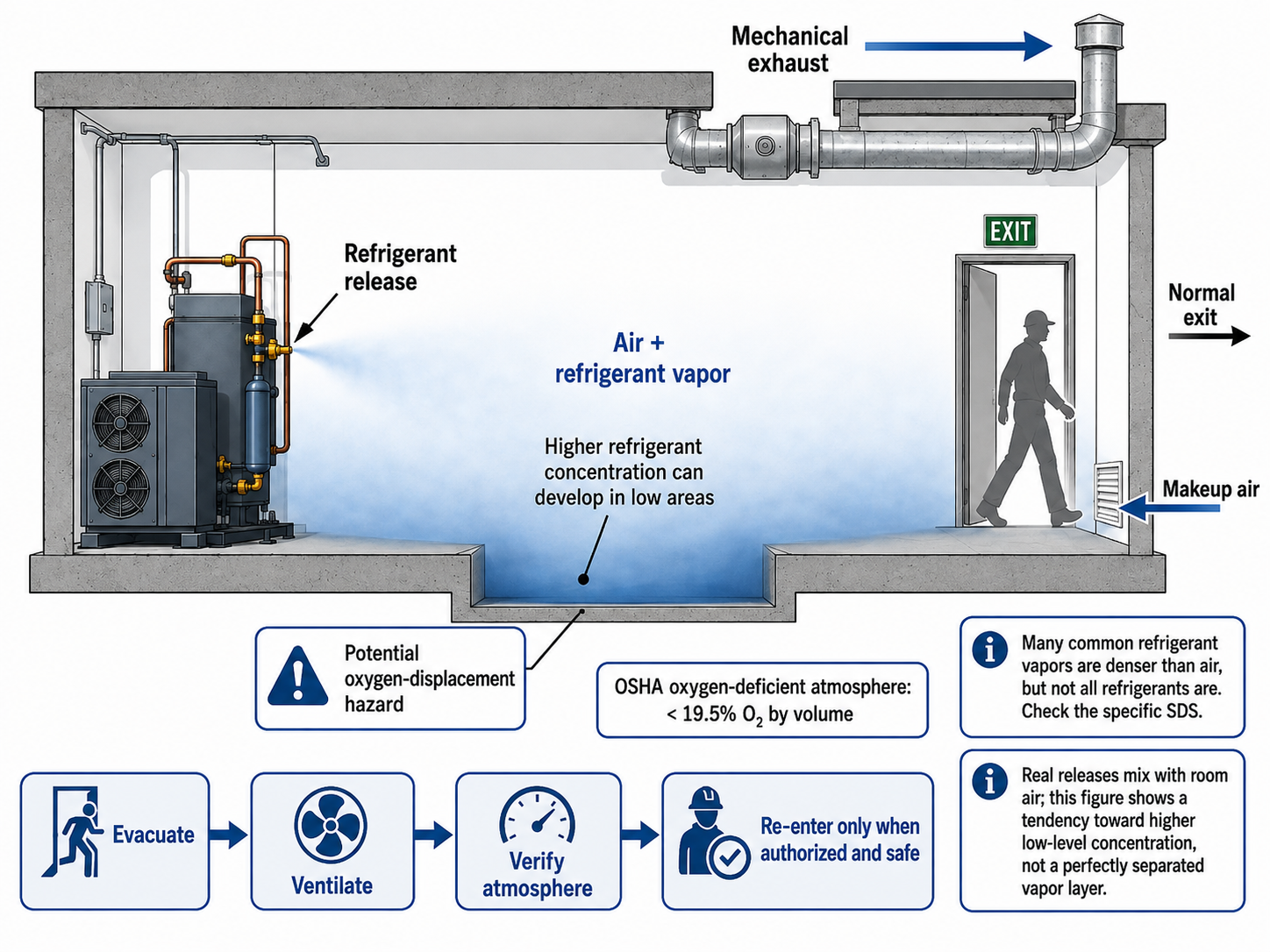
Figure 6.2.1 – Refrigerant vapor can create higher concentrations in low areas when the vapor is denser than air and ventilation or mixing is inadequate.
AI-generated instructional figure: It may contain visual inaccuracies. Use the accompanying lesson text and cited authoritative sources to verify technical and regulatory details.
EPA 608 Exam Focus
What Students Must Remember
EPA’s current Core safety topics include:
- Oxygen deprivation.
- Cardiac effects.
- Frostbite.
- Long-term exposure hazards.
- Gloves.
- Goggles.
- SCBA in extreme cases.
For Section 6.2, remember:
Large refrigerant release
→ can displace air
→ oxygen can decrease
→ asphyxiation hazard
High-Priority Number
< 19.5% oxygen
→ OSHA oxygen-deficient atmosphere
High-Priority Distinctions
| Do Not Confuse | Correct Distinction |
|---|---|
| Oxygen displacement and toxicity | Oxygen can fall because refrigerant displaces air; some refrigerants can also produce direct physiological effects |
| Oxygen concentration and refrigerant exposure concentration | Acceptable oxygen does not automatically mean the refrigerant level is acceptable |
| Dense vapor tendency and universal behavior | Many common refrigerants can collect low; not every refrigerant is heavier than air |
| Machinery room and confined space | A machinery room may be hazardous without meeting the OSHA confined-space definition |
| Confined space and permit space | A permit space is a confined space with an additional serious hazard |
| Air-purifying respirator and SCBA | A filter respirator does not supply missing oxygen; SCBA carries breathing gas |
| Ventilation running and safe re-entry | Ventilation must be followed by hazard evaluation and applicable atmospheric verification |
| Escape equipment and entry equipment | Equipment suitable for escape is not automatically suitable for entry or rescue |
Likely Question Patterns
Students may be asked:
- Why refrigerant vapor can cause oxygen deprivation.
- Why a low area may contain a higher refrigerant concentration.
- What oxygen concentration OSHA defines as oxygen deficient.
- Whether all refrigerants are heavier than air.
- Why odor is not a reliable indicator of atmospheric safety.
- What cardiac sensitization means.
- Why a cartridge respirator cannot protect against oxygen deficiency.
- What SCBA provides that an air-purifying respirator does not.
- Whether an ordinary machinery room is automatically a confined space.
- What should happen first after a major refrigerant release.
- Why an unknown atmosphere should not be entered casually.
- Why an untrained technician should not attempt a confined-space rescue.
Common Mistakes and Confusing Points
Mistake 1: Thinking Refrigerant Must Be Poisonous to Cause Asphyxiation
A gas can create an asphyxiation hazard simply by displacing oxygen-containing air.
Mistake 2: Assuming All Refrigerants Are Heavier Than Air
Many common halocarbon refrigerants are denser than air, but the statement is not universal.
Check the specific refrigerant properties.
Mistake 3: Imagining a Perfect Refrigerant Layer at the Floor
Real releases mix with room air.
A dense refrigerant may create a higher concentration near low points, but room turbulence, ventilation, and thermal motion prevent a perfectly sharp boundary.
Mistake 4: Measuring Oxygen Only at Head Height
A low pit can have a different atmosphere from the main room.
Testing must evaluate the locations relevant to worker exposure and the applicable entry procedure.
Mistake 5: Assuming 19.5% Oxygen Means the Atmosphere Is Completely Safe
The oxygen level can be above 19.5% while the refrigerant concentration is still unsafe for another reason.
Mistake 6: Relying on Smell
The absence of odor does not establish that the atmosphere is safe.
Mistake 7: Treating Cardiac Sensitization as the Same as Asphyxiation
They are different mechanisms.
- Asphyxiation concerns inadequate oxygen.
- Cardiac sensitization concerns the heart’s response to sufficiently high concentrations of certain vapors.
Mistake 8: Entering to Shut a Valve After Everyone Else Evacuates
Emergency isolation must be performed only under an established procedure by trained and properly equipped personnel.
Mistake 9: Assuming a Fan Makes the Room Safe Immediately
Ventilation takes time and may not remove every low-level pocket.
The atmosphere must be evaluated according to the applicable procedure.
Mistake 10: Using a Dust Mask or Cartridge Respirator for Oxygen Deficiency
Air-purifying respirators do not supply oxygen.
Mistake 11: Treating SCBA as Ordinary Optional PPE
SCBA use requires the proper respiratory-protection program, training, medical evaluation, fit testing where applicable, inspection, and emergency procedures.
Mistake 12: Calling Every Mechanical Room a Confined Space
Apply the actual OSHA definition:
- Bodily entry for work.
- Limited/restricted entry or exit.
- Not designed for continuous occupancy.
Mistake 13: Attempting an Unplanned Rescue
A person entering an oxygen-deficient or refrigerant-contaminated confined space without the required equipment can become another victim.
Concept-Check Questions
Question 6.2-1
How can a large refrigerant release create an asphyxiation hazard even if the refrigerant does not chemically consume oxygen?
A. The refrigerant can occupy space that was previously filled with oxygen-containing air.
B. The refrigerant converts oxygen into liquid water.
C. The refrigerant causes the oxygen molecules to become heavier.
D. Every refrigerant chemically reacts with oxygen immediately.
Question 6.2-2
Under OSHA general-industry terminology, which atmosphere is oxygen deficient?
A. Less than 23.5% oxygen
B. Less than 21.0% oxygen
C. Less than 19.5% oxygen
D. Less than 15.0% oxygen only
Question 6.2-3
Which statement about refrigerant vapor density is most accurate?
A. Every refrigerant vapor is heavier than air.
B. Every refrigerant vapor is lighter than air.
C. Vapor density is irrelevant because all refrigerants mix instantly and uniformly.
D. Many common refrigerant vapors are denser than air and can create higher concentrations in low areas, but the specific refrigerant must be checked.
Question 6.2-4
A refrigerant alarm activates in a mechanical room. No refrigerant odor is noticeable. What is the best response?
A. Ignore the alarm because a dangerous release would always have a strong odor.
B. Follow the facility’s evacuation and emergency procedure and do not use odor as proof that the atmosphere is safe.
C. Enter the room and remain there until symptoms appear.
D. Disable the alarm and continue service.
Question 6.2-5
Which statement correctly distinguishes oxygen deprivation from cardiac sensitization?
A. They are two names for exactly the same hazard.
B. Oxygen deprivation results from inadequate oxygen availability, while cardiac sensitization is a direct physiological effect associated with sufficiently high exposure to certain vapors.
C. Cardiac sensitization occurs only when oxygen falls below 10%.
D. Oxygen deprivation occurs only with flammable refrigerants.
Question 6.2-6
Why is an ordinary air-purifying cartridge respirator not adequate protection for an oxygen-deficient atmosphere?
A. It is too heavy for HVAC work.
B. It can filter contaminants but does not supply the missing oxygen.
C. It always increases refrigerant concentration inside the mask.
D. OSHA permits it only for eye protection.
Question 6.2-7
Which of the following best matches the OSHA general-industry definition of a confined space?
A. Any room containing refrigeration equipment
B. Any room smaller than 1,000 ft²
C. A space large enough for bodily entry and work, with limited or restricted entry or exit, and not designed for continuous employee occupancy
D. Any space with a refrigerant detector
Question 6.2-8
A technician sees a coworker collapsed at the bottom of a pit after a refrigerant release. What is the safest immediate principle?
A. Enter immediately without respiratory protection because rescue takes priority over atmospheric testing.
B. Hold one’s breath and enter quickly.
C. Start an unplanned rescue using an air-purifying dust mask.
D. Activate the emergency response and do not enter the hazardous space without the required rescue training, respiratory protection, and confined-space procedure.
Section Summary
A refrigerant release can create a serious respiratory hazard by displacing normal air.
The core relationship is:
Refrigerant enters space
→ less normal air remains
→ oxygen concentration can decrease
→ judgment and physical ability can deteriorate
→ unconsciousness / asphyxiation can occur
The major concepts are:
- OSHA defines an oxygen-deficient atmosphere as less than 19.5% oxygen by volume.
- Many common refrigerant vapors are denser than air and can create higher concentrations near floors, pits, and other low areas.
- Not every refrigerant is heavier than air; use the specific SDS.
- Real releases mix with room air rather than forming a perfectly separated layer.
- Oxygen deprivation and direct refrigerant toxicity are different hazards.
- Some refrigerants can produce CNS and cardiac effects at sufficiently high concentrations.
- Acceptable oxygen does not automatically prove that refrigerant exposure is acceptable.
- Odor is not a reliable atmospheric-safety indicator.
- Evacuation is the correct response to a significant or uncertain refrigerant atmosphere unless a trained and equipped emergency procedure specifically requires another action.
- Ventilation helps dilute and remove refrigerant but does not automatically prove safe re-entry.
- A refrigerant monitor and an oxygen meter answer different safety questions.
- An air-purifying respirator does not supply oxygen.
- SCBA or another qualifying atmosphere-supplying respirator is used for applicable IDLH conditions by properly trained personnel under a respiratory-protection program.
- A machinery room is not automatically an OSHA confined space.
- A permit-required confined space has one or more additional serious hazards.
- Never attempt an unplanned entry or rescue into an oxygen-deficient, unknown, or refrigerant-contaminated confined space.
The next section addresses fire, ignition, compressed-air/oxygen, and thermal-decomposition hazards.
See Section 6.3 - Fire Explosion and Decomposition Hazards.
References
Current EPA Examination Source
- U.S. Environmental Protection Agency, Test Topics — Section 608 Technician Certification, Core safety topics including oxygen deprivation, cardiac effects, frostbite, long-term exposure hazards, gloves, goggles, and SCBA in extreme cases. Accessed August 10, 2026.
Current OSHA Regulatory Sources
-
Occupational Safety and Health Administration, 29 CFR 1910.146 — Permit-Required Confined Spaces, definitions of confined space, permit-required confined space, hazardous atmosphere, IDLH, oxygen-deficient atmosphere, and oxygen-enriched atmosphere. Accessed August 10, 2026.
-
Occupational Safety and Health Administration, 29 CFR 1910.134 — Respiratory Protection, respiratory-hazard evaluation, NIOSH-certified respirators, IDLH respirator selection, SCBA requirements, medical evaluation, fit testing, training, inspection, and respiratory-protection programs. Accessed August 10, 2026.
-
Occupational Safety and Health Administration, Clarification of OSHA’s Requirement for Breathing Air to Have at Least 19.5 Percent Oxygen Content, oxygen-deficient atmosphere and IDLH interpretation. Accessed August 10, 2026.
Technical and Health References
-
National Institute for Occupational Safety and Health, Health Hazard Evaluation Report HETA-89-0344-2157, discussion of fluorocarbon exposure, cardiac effects, cardiac sensitization, arrhythmias, and asphyxiation hazards in high-exposure and confined-space scenarios.
-
Rex Miller and Mark R. Miller, HVAC Licensing Study Guide, 3rd ed., Chapter 6, refrigerant toxicity, central-nervous-system effects, cardiac sensitization, vapor accumulation, and refrigerant-safety discussion.